

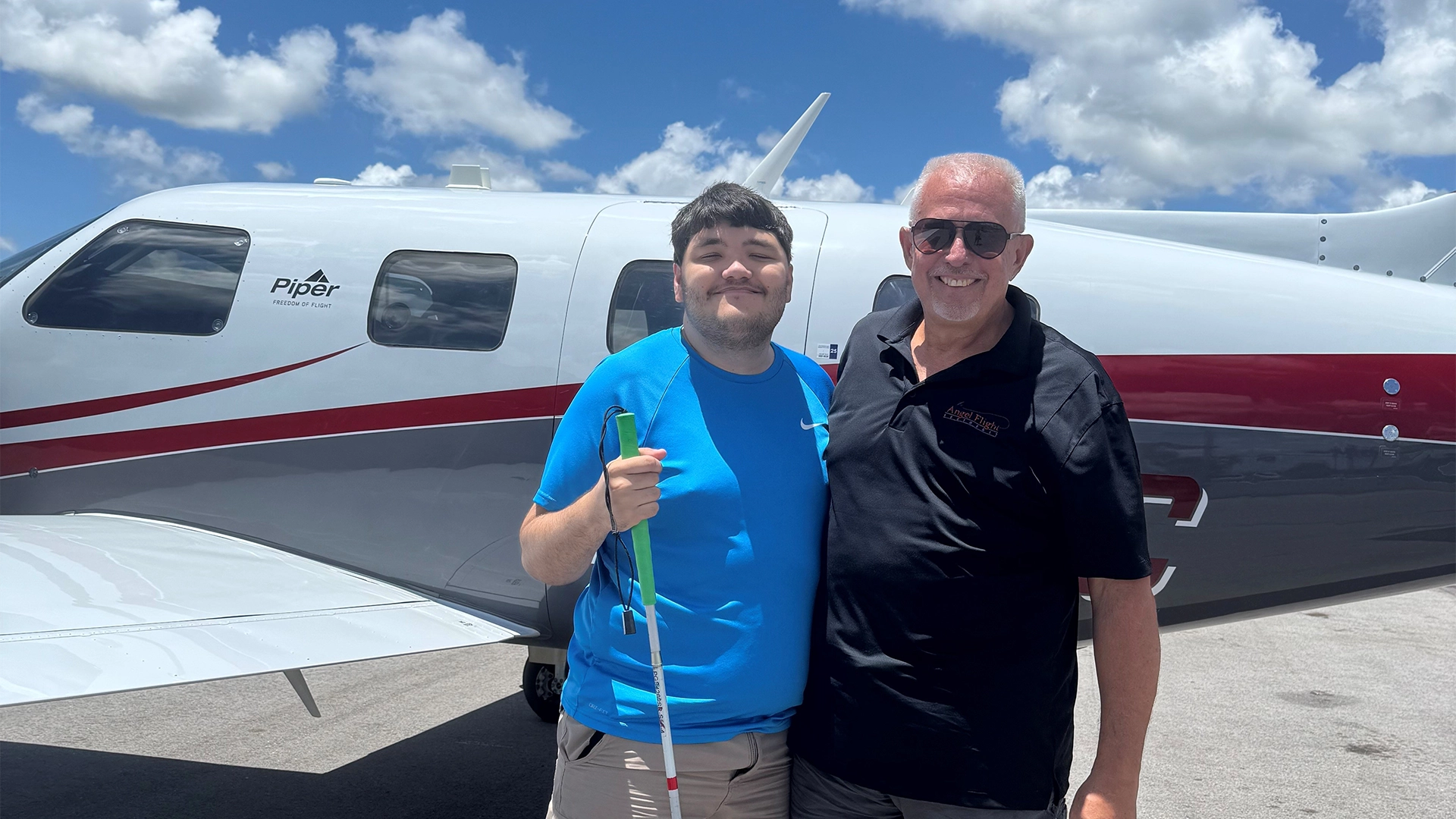
The many ways that general aviation and business aircraft pilots can volunteer their time and equipment to help those in need includes Angel Flight, a group of independent charitable organizations that provide free flights for people seeking medical treatments at locations that are often hundreds of miles away from their homes.
South Florida-based pilot David Campbell first volunteered with Angel Flight Southeast in early 2025, four years after earning his pilot certificate and instrument rating and six months after purchasing his piston-engined Piper M350. “I’m retired and wanted to fly as much as I possibly could, but I was tired of breakfast runs and flying around Florida,” he said.
Courtesy David Campbell
Required pilot-in-command time varies by organization, but a common minimum is 250 hours. “A lot of pilots like me are building time,” said Campbell, who’s nearing 1,000 hours. “Angel Flight gives me the opportunity to fly with a purpose.”
“Angel Flight gives me the opportunity to fly with a purpose.”
David Campbell
Pilot, Angel Flight Southeast
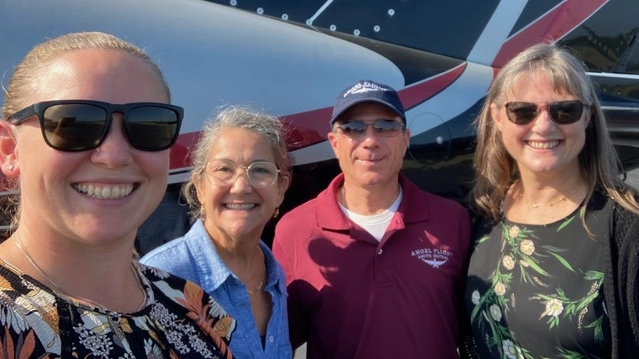
Another Angel Flight aviator, Hogan “Brian” Brooks began flying for Angel Flight South Central in May 2021. Earlier this year, the Texas-based pilot completed his 1,000th mission for the organization, logging more than 372,000 miles – equivalent to circumnavigating the globe 15 times.
Courtesy Hogan “Brian” Brooks
“My parents taught me to give back when you can,” Brooks said. “If you find something that you love to do, and you’re able to give back at the same time doing what you love to do, that’s the best of both worlds.”
Easing Patient Worries
From his home airport outside Houston, Brooks is well-positioned to perform flights to the Texas Medical Center complex that includes MD Anderson Cancer Center. His pressurized, Piper M600 turboprop enables him to transport patients nonstop from 500-700 miles away within three hours.
“I can hear the relief in a patient’s voice when I pick up the phone to say I have their trip,” Brooks said. “They know they’re able to get to treatment and return home without driving for 12 hours or going through TSA. This is one part of their healing experience they don’t need to worry about.”
“They know they’re able to get to treatment and return home without driving for 12 hours or going through TSA. This is one part of their healing experience they don’t need to worry about.”
Hogan “Brian” Brooks
Pilot, Angel Flight South Central
Both Campbell and Brooks illustrate yet another example of business aviation’s many and varied societal benefits. The ability of business and GA aircraft to operate on flexible schedules and fly to smaller airports that are not served by airlines makes the sector a perfect fit for transporting medical patients for treatment in far-away places.
‘He’s Just as Happy as Could Be’
Among Campbell’s passengers this year was a mother and her 4-year-old son who had undergone a kidney transplant in Miami. “Transplant patients fly in and out of Miami International Airport” [MIA], he said. “That was definitely a new experience for me.”
In addition to the challenge of operating among commercial airliners and other large aircraft, Campbell learned the boy’s surgery had taken place just three days earlier. “He was obviously still very much in recovery mode,” he added. “We got them loaded and ready to go, and soon I’m taxiing out behind a huge FedEx jet. ATC held them so we could depart first.”
While climbing out from the runway, “I hear squealing from the back of the plane,” Campbell said. “I’m focused on flying – it’s a true IFR day – but I’m also concerned something might be wrong. But once I had a chance to look back, I see that he’s just happy as could be.”
Campbell later learned the boy loved flying. With every cloud they flew through, “he’s back there squealing and happy and laughing,” he continued. “So, I decided I’m just going to fly through every cloud that I can!”
Experiences like those are just a few of the reasons why both men encourage other pilots to volunteer with Angel Flight or similar organizations.
“Flying with complete strangers is a new experience, particularly those with medical issues, but everybody I’ve flown has been just super nice and beyond appreciative,” Campbell said. “The uncertainty of flying with people who aren’t your family or friends passes quickly. And since many of them have recurring appointments, I always ask them to ask for me.”
“Deep down, I think all pilots want to help,” Brooks added. “It’s a great way for younger pilots to build time and it’s a great way to give back, whether it be for Angel Flight, Pilots and Paws [which flies rescue animals to new homes] or any of the other organizations that are out there.
“The Angel Flight motto is, ‘Half the cure is getting there,'” he concluded. “That’s what it’s about.”