

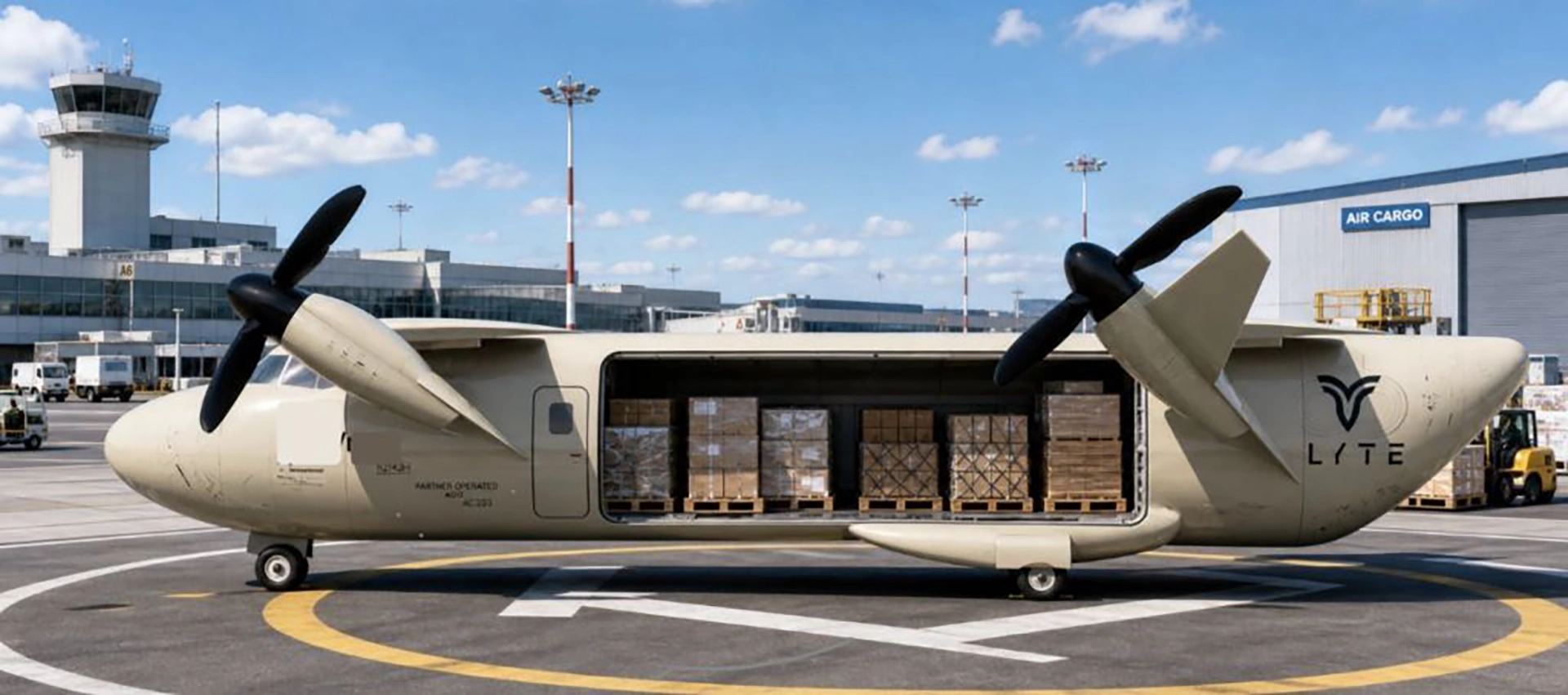
A new advanced air mobility (AAM) concept aims not only to transport dozens of passengers or 4.5 tons of cargo across distances of up to 1,000 kilometers, but also to expand business aviation’s unique ability to deliver medical and humanitarian support to remote and underserved regions.

Founded in 2023 by CEO Freshta Farzam, LYTE Aviation describes its ambitious SkyBus LA-44 as “the world’s first heavyweight hydrogen-hybrid VTOL [vertical takeoff and landing] platform.” Designed to carry up to 40 passengers on regional routes, SkyBus represents a significant departure from many AAM programs centered on air taxis carrying only two to six passengers.
The concept also appears to align well with the business aviation industry’s ability to operate medical and humanitarian missions during crisis situations, reaching isolated areas that traditional airlines or automobiles cannot by using small regional runways, unpaved airstrips, and even roadways.
Business and volunteer aircraft complete around 15,000 charitable and medical flights each year, flying over 118,000 hours to support vulnerable communities globally, according to the industrywide advocacy initiative CLIMBING. FAST.
Proposing a Key Question
“When I first saw air taxi concepts around 2020, I kept asking why everyone was focused on the smaller vehicles,” Farzam said. “Why wasn’t anyone trying to scale it up?”

That question prompted Farzam and her engineering team to examine the technical challenges associated with larger vertical-lift aircraft. They ultimately concluded that a hybrid architecture combining conventional turbine engines with hydrogen fuel-cell technology offered a practical path forward.
“We initially looked at 20 passengers, but I felt we could do more,” Farzam said. “That’s when we pushed to 40 passengers. Hybrid propulsion was really the key that allowed us to think bigger.”
“Hybrid propulsion was really the key that allowed us to think bigger.”
Addressing a Transportation Gap
That places SkyBus in a unique niche between smaller eVTOL air taxis, heavyweight helicopters like the Boeing CH-47 Chinook and regional airliners such as the ATR 42 turboprop. Farzam believes the concept addresses a transportation gap that has received relatively little attention.
“It has struck a nerve in the market,” Farzam said. “People realize there’s a need for something larger than an air taxi but more flexible than traditional regional transportation.”
A New Option for Critical Humanitarian Care
Beyond passenger transportation, LYTE Aviation is also developing both a SkyTruck cargo variant and SkyClinic, a deployable medical facility. SkyClinic emerged as the company evaluated the aircraft’s substantial cabin volume and considered potential applications for emergency medical services and disaster-response missions.
“We started asking what we could do with all of that space,” Farzam said. “Then we began exploring how advanced medical robotics and remote surgery technologies have become.”
Farzam envisions SkyClinic as a mobile treatment center capable of bringing surgical care directly to areas where hospitals, roads and other critical infrastructure have been damaged or destroyed. The flexible interior may be configured for a range of missions, from advanced robotic surgery suites to more traditional hospital layouts suitable for regions with limited medical capabilities.
The platform could prove especially valuable during natural disasters, humanitarian crises and public health emergencies. “When disasters occur, one of the first things affected is infrastructure,” Farzam said. “Roads, hospitals and airports may no longer be available. We want to be able to arrive quickly and provide care where it’s needed.”

“When disasters occur, one of the first things affected is infrastructure,” Farzam said. “Roads, hospitals and airports may no longer be available. We want to be able to arrive quickly and provide care where it’s needed.”
Blending the Future with the Past
One source of inspiration for SkyBus and its variants came from aviation history. During her research, Farzam learned about the Fairey Rotodyne, a British compound gyroplane developed in the 1950s that was designed to transport approximately 40 passengers while retaining vertical takeoff and landing capability.
While the Rotodyne proved to be too far ahead of its time, “that gave me confidence,” she said. “If engineers were thinking about a 40-passenger VTOL aircraft in the 1950s, then surely we can achieve something similar with today’s technology.”
How the Powertrain Works
LYTE Aviation recently redesigned the SkyBus propulsion system to reduce weight and improve efficiency through a proprietary dual-power coupling gearbox. Dubbed PowerBridge, the architecture combines four Jet-A-powered turbine engines with four electric propulsion units supplied by hydrogen fuel cells.
According to Farzam, the redesign reduced overall aircraft weight by eliminating unnecessary propulsion components and simplifying the powertrain. The new gearbox arrangement also enables significantly greater use of electric propulsion during flight.
“In our earlier configuration, we could only use a small percentage of the available electric power,” she said. “The coupling system allows us to maximize the electric side of the propulsion system while reducing power from the combustion engines.”
The market appears to be taking notice. According to Farzam, LYTE Aviation has secured 33 preorders valued at approximately $1.4 billion, including 10 conditional SkyClinic orders from the India-based leasing group Vman Aviation Services, providing what she describes as strong validation of the company’s concept and long-term vision.
The company recently completed its preliminary design review and is now pursuing additional investment to support prototype development and eventual certification efforts. Farzam believes the broader AAM industry may ultimately help accelerate LYTE Aviation’s path to market.
“The companies that came before us have done a tremendous amount of work with regulators and certification authorities,” Farzam said. “They’ve opened many of the doors that will benefit the entire industry. We know there’s a long journey ahead, but we absolutely believe it’s achievable.”