
When construction company Silver Maple in 2023 took on building a huge new eco-friendly hangar in Concord, NH, it naturally started sourcing steel. But its client, a biotech company pioneering a new model for organ transport, needed the project quickly – and wood was faster to secure than steel.
So, with the client’s approval, the project on Concord Municipal Airport (CON), transformed into a cutting-edge, zero-carbon facility made of mass timber – superstrong, engineered wood.
“Our client came to us and said they needed a large hangar with no carbon footprint and they needed it in a year,” said Silver Maple CEO Sean Flynn. “We were excited to build them this green building that’s really a showpiece.”
“Our client came to us and said they needed a large hangar with no carbon footprint and they needed it in a year. We were excited to build them this green building that’s really a showpiece.”
Silver Maple CEO Sean Flynn
A Cavernous Hangar With Massive Doors
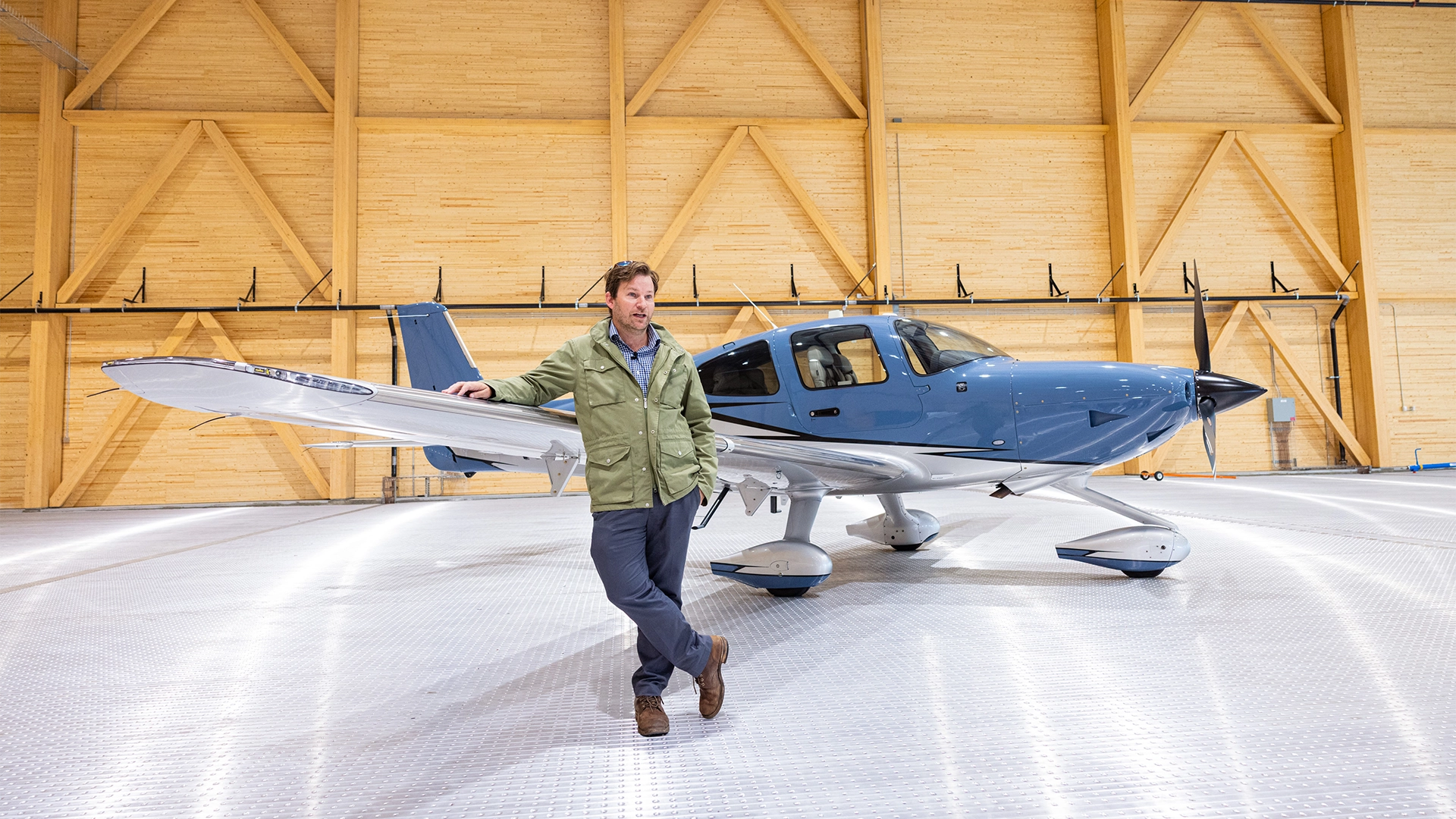
The finished project – the world’s first net-zero mass timber hangar – is cavernous, with a 210-foot clear span and clocking in at about 36,000 square feet in area. The two hangar doors – the larger of which is 30 feet tall by 120 feet wide and weighs 60,000 pounds – are operated by hydraulic pumps.
The building is highly functional, aesthetically pleasing and made of cutting-edge renewable materials. From this base, Silver Maple’s biotech client operates a fleet of helicopters and airplanes to deliver organs for transplant up and down the Eastern Seaboard.
In the near future, the company plans to decrease its carbon footprint even further by adapting zero-emissions electric air taxis for organ transport, all based out of its sustainable hangar.
Because it is made primarily of wood products, the hangar actually sequesters a significant amount of atmospheric carbon. Remarkably, by some calculations, it is actually responsible for negative carbon emissions.
“There are a thousand ways to look at it, but I think we’re at negative 256 tons of carbon on the overall building,” explained Flynn. “That’s a compelling argument for a really green building.”
Silver Maple’s mass timber hangars represent yet another example of the business aviation industry’s ability to find new ways to operate with decreased net carbon emissions and increased sustainability. These kinds of innovations help push business aviation closer to achieving its overall goal of net-zero emissions by 2050, a key pillar of the industrywide CLIMBING. FAST. initiative.
“There are a thousand ways to look at it, but I think we’re at negative 256 tons of carbon on the overall building. That’s a compelling argument for a really green building.”
Silver Maple CEO Sean Flynn
What Is Mass Timber?
Mass timber construction uses large beams made up of a cross-lattice of many smaller pieces of wood. It is much stronger than regular timber. (Another term for it is glue-laminated timber, or “glulam.”) And because glulam is so dense, it’s also much more fire-resistant than regular timber. According to Silver Maple, mass timber chars at a predictable rate and retains load capacity behind the char layer, verified by ASTM E119 testing. Therefore, it will perform better in a fire than steel beams, which eventually fail in high enough heat.
The building’s entire superstructure was built using glulam made from black spruce trees: Its curved roof is framed with 210-foot clear-span wood-and-steel trusses that weigh 50,000 pounds each – the largest Silver Maple’s supplier had ever built. The trusses are supported by 42-foot wood columns. The lateral framing is made of chevron-braced mass timber supports.
The building’s exterior walls are made of about a hundred 10-foot-by-42-foot wood panels that were prefabricated offsite. It took just eight days for the sections to be installed, helping enable the builder to meet the tight project timeline. The outside of the panels is coated in Richlite, an attractive, sustainable paper-based material.
Additionally, instead of employing a toxic foam-spewing fire-suppression system, the hangar features almost 34,000 square feet of Safespill flooring to whisk away spilled oil or fuel so it can’t harm people or damage aircraft if it ignites.
“I truly hope that this project sets a precedent for future hangars,” said Flynn, whose company has taken on additional mass timber hangar projects since the completion of the Concord project. “The fact that we pulled this off at all, much less at the pace and carbon footprint that we achieved, proves that it can be done.”